March 17, 2015

The Blog's Tomorrow and Link-Sharing!


Spring. Travel. De-cluttering. It's got me thinking about where this blog is headed to - and if it has run its course. Should I start something completely new? Or not? I am increasingly using Instagram as that space to muse or ramble and I feel that a lot of what I post here simply seems to be an extension of my Insta-thoughts.

As I ponder further about the blog's tomorrow, I would like to jump on the link-sharing post bandwagon that I have seen on several blogs that I follow. I am mostly on Twitter to check out the interesting links and be privy to multiple conversations so it's easy to lose track of what you discover and more importantly, what you would really like to share...so thought I would present my list of what caught my fancy in the last few weeks.

*I can't remember when I first started reading Gretchen Rubin's blog but it's always been an useful and thought-provoking resource, encouraging me to think about about how introducing seemingly minimal changes into my routine and lifestyle can contribute to a happier bigger picture. I have yet to read any of her books but I have been following her blog for years. She's going to launch a book about cultivating habits tomorrow and she had been interviewing a personality each week to learn more about their habits in the run up towards the book's release. While I enjoyed reading and learning more about the author, Hannah Nordhaus's habits, what I was even more intrigued by was the book she's recently written, American Ghost: A Family's Haunted Past in the Desert Southwest. Ghost, gender, desert, memoir, travelogue: this is exactly my sort of book!

*Having written nothing but poetry for the first ten years of my writing life, I abandoned it for fiction and then, subsequently, non-fiction and journalism. I have started to write poetry in fits and spurts again and even though the results are far from what I would be satisfied with, it's nonetheless giving me pleasure. I thought this was a beautiful piece about an ecologist mother turning to poetry to provide succor to her troubled teenage daughter.

*I so want to visit Spiti Valley after reading this!

*I fell in love with Chinki Sinha's stunningly written essay about the travails of love in the time of internet. Just take the opening paragraph for instance: "And then, there were no lilies. Although when she stops by the florist sometimes, she tries to imagine what a thousand of them would look like. Then, she hurries to the grocery store, and never buys lilies. The promise of lilies remained suspended. In time, and in anticipation, and later in memory."

*I have bit of an issue with the notion of a day called Women's Day! For me, it amounts to tokenism, simply singling out a day for half of the world's population to recognise, revere, and respect their innate strength and dignity...when it instead should be a constant, continuous process to be performed every single day, rather than just one. Nevertheless, when National Geographic asked seven of their women photographers to share a powerful image of the women they have photographed over the years in honor of Women's Day, they came up with these moving photo-stories...and which I found hugely inspirational.


PS My first post without pictures! Well, that's a first for this blog...


March 11, 2015

Japanese performance and installation artist, Chiharu Shiota: Drawing Memories in the Air


Trace of Memory, The Mattress Factory, 2013 (Photo: Priyanka Sacheti)

I remember being thoroughly enchanted the first time I encountered Japanese installation and performance artist, Chiharu Shiota's work, Trace of Memory at The Mattress Factory, a contemporary art museum in Pittsburgh. I had been wanting to visit this curiously named museum all throughout the time I had been living there but I only managed to make time just a couple of days before I left the city - and am I glad I did! I had been primarily interested in dropping by the museum to see the work of another Japanese artist, Yasoi Kusama, whose signature polka dot + infinity mirror installation works were one of the museum's most exciting and fun spaces and which I regularly saw popping up on my Instagram feed. However, I returned from the museum visit, having become a big Chiharu Shiota fan instead and subsequently eagerly read up on her large, varied body of work. Almost a year later, I have been fortunate enough to personally interact with the artist when I recently. blogged about her work at Her Blueprint, where I regularly write about international women artists. Read on to find out more...

Chiharu Shiota's Mattress Factory installation utilised both the spatial landscape of an abandoned 19th century row house as well as specific objects such as a wedding dress, hospital bed, and a pile of suitcases and which she enmeshed it all in intricate black wool-thread creations. Everything was visible and yet, not; it was not unlike cobwebs studding the dusty corners of an abandoned house, simultaneously representing decay and life. In a sense, Shiota's work resurrects an otherwise dead house, creating a physically tangible web of narratives through the confluence of thread, space, and air. Perhaps, enchanted was also an appropriate word to describe my engagement with her work, for there was a fairy-tale, other-worldly quality to her work that I had never previously witnessed or experienced elsewhere. Researching further and talking with the artist herself, I discovered that the wool-thread is a signature motif of her work and through which she quite literally binds memories, past, people, and objects.

Born in Osaka, Japan, Chiharu moved to Berlin, Germany in 1997, where she studied with Marina Abramovic and Rebecca Horn, forerunners of the performance art movement; she has exhibited all over the world, presenting her installation art in both solo and group exhibitions.

What does installation art specifically mean to her? “I love empty spaces; the minute I come across one such as an abandoned building or an empty exhibition space, I feel as if my body and spirit transcend a certain dimension - and I can then start from scratch,” Chiharu says, presenting the abandoned or blank exhibition space as one void of references or associations and which she is subsequently free to re-interpret and realise her imagined worlds in. What particularly excites her about installation art is the immediacy of communication and engagement with the viewer. “[The viewers] can immediately feel as to what I am trying to show...unlike a painting or sculpture where you may have to engage with it for quite a while before distilling its meaning,” she opines.

While her work is largely rooted in the soil of her personal memories and concerned with theme of remembering and oblivion, it also sprouts and entwines itself with larger collective memories as well; one glimpses it in installations such as Dialogue from DNA in Krakow, Poland and which was subsequently recreated in Germany and Japan. Currently living and working in Germany, Chiharu reminisces about how it is linked to the time she returned to Japan three years after moving to Germany. "I wore my old shoes and experienced a curious situation; they didn't fit me any more even though they were the same size. This sense of dislocation persisted even when I was interacting with my parents and old friends. Nothing specifically had changed - and yet, I felt differently about them," she says.

The scenario made her start thinking about the gulf between the idealised memories when one is away from the home and yearning to return to it -- and actually being in home itself. "I began to interrogate the idea of missing and memories and I fused it with the idea of old shoes and the memories associated with them," she says, elaborating that the installation consisted of 400 disused shoes that people had donated along with notes containing specific memories associated with the shoe. Looking at the installation (below), it is almost as if the threads anchor the memories in form of the shoes in place, lest they vanish into nothingness and being unremembered.

Chiharu Shiota, Dialogue from DNA, (2004) Manggha, Centre of Japanese Art and Technology, Krakow, Poland, Shoes, Thread Photograph: Sunhi Mang

Chiharu has often remarked that working with thread is a bit like drawing in air. “When I began working as a painter, I felt that two-dimensional drawings were limiting me. I needed more space so I started working on installations and using thread in order to achieve a three dimensional drawing, so to speak. The threads since then have been a fundamental aspect of my work,” she says. These threads represent multiple meanings in her diverse output of work, whether of connections or ensnarement or opacity.

Apart from the threads embroidering the surface of Chiharu's installation spaces, they are also home to objects which Chiharu frequently and quite literally weaves into her works; these objects are plucked from the quotidian, facilitating both the unspooling of a narrative while crucially being a narrative in themselves. They also signify absences, absences which become the works' fundamental bedrock. "Specific objects inspire me when I experience a personal association or link with them as I did when putting on my old shoes. Abandoned objects are laden with even more memories and associations," she mentions, suggesting that this surplus of memories adds further narrative texture to her work. "The object itself has a meaning, being a signifier and then my role would be to weave its memories and meaning together using the threads."
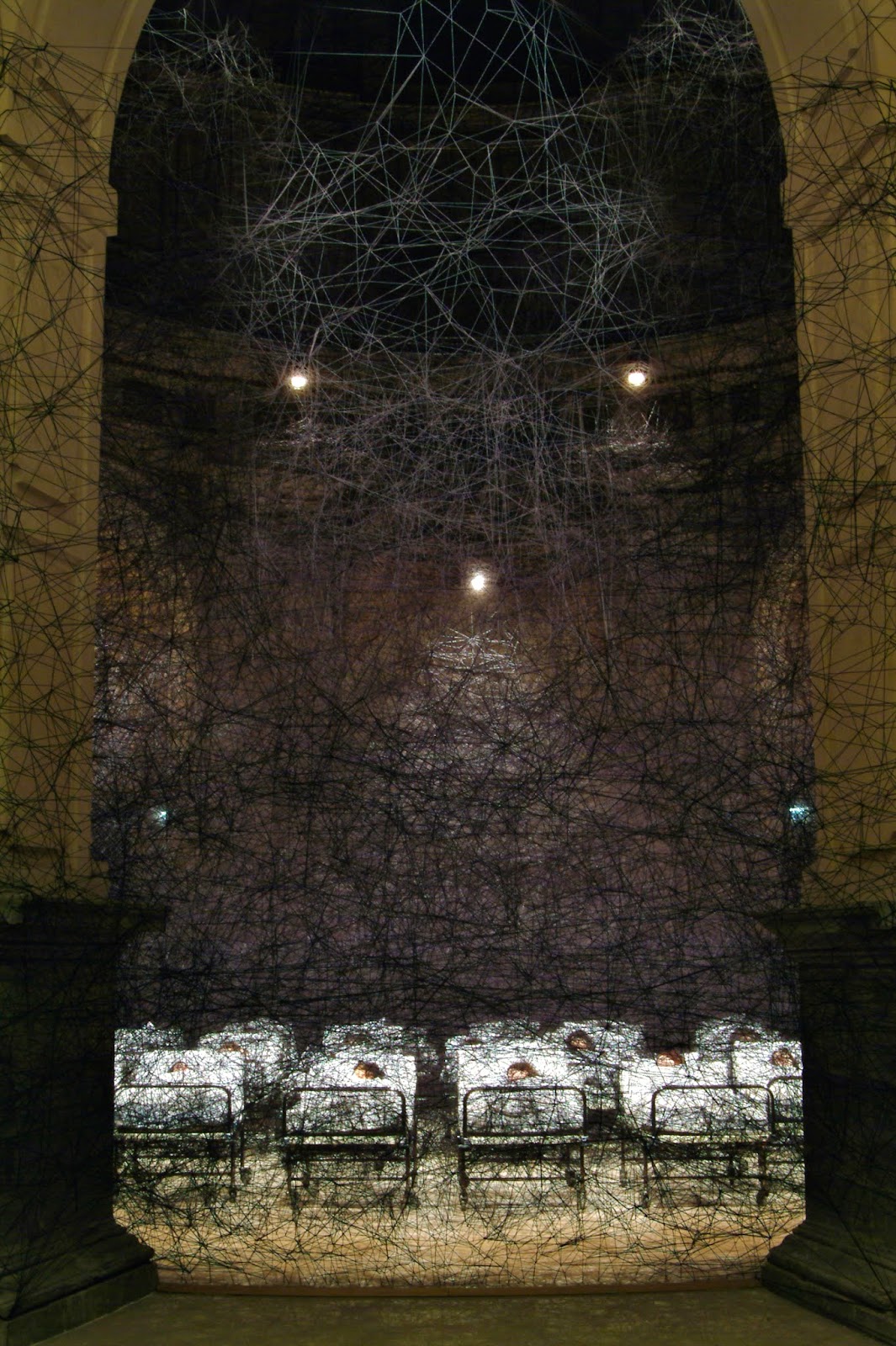
Chiharu Shiota, During Sleep, (2004), Saint-Marie-Madeleine, Lille, France, Thread, Beds, Performers
Photographer: Sunhi Mang

While objects frequently figure as the central components of her installation works, her works are also distinctively body-oriented, as evidenced in works such as During Sleep, which features real-life women asleep on hospital beds and the space enshrouded in her customary fog of thread, bringing to forth gendered associations with the fairy-tale Sleeping Beauty.

February 26, 2015

A Semblance of Spring in the Air


The winter is nearing its conclusion over here - and I can smell a semblance of spring in the air. However, I can't help but think about spring in a city in a country thousands of miles away though. At the moment, it is probably bone-white and a punch-in-the-solar-plexus cold and unrelentingly blank there; yet, there are also stubbornly budding trees, determined to fruit and flower in spite of the cold and ice. Isn't it the season of magnolias? Have the cherry blossoms emerged yet? I suddenly experience a strong, almost unbearable nostalgia, imagining standing on my Pittsburgh apartment balcony and witnessing the dead landscape gradually being resurrected in the months to come.


Fish-flowers


However, this much I acknowledge: nature offer its gifts wherever you go. There will be new trees and flowers to encounter over here too. In the meantime, I see paint daubs of orange and red everywhere, even in cloth bundles unspooling on the ground. Bright orange flowers erupt like fishes shimmying in and out of a choppy green sea.


Illumination


Red in Death

Fat, flamboyant, maximalist orange flowers illuminate an otherwise austere tree; nudged on by the dusk breeze, they gently fall, descend and lie upon the ground, turning blood-red as they decay. I must find out their name, I really must. From my study window, I can see nests sharing branch-space with fat chocolate brown seed pods on the tree growing outside. I collect fallen leaves, flowers and seed-pods; I photograph them, I make whimsical little arrangements out of them and leave for passerby's to discover.

Suspended, in hope

Wherever I have lived, whichever place I have called home, there has been a tree growing outside my window; its branches, whether leaf-laden or not, have represented an embrace, that of hope and succor.
A few days ago, while walking past a fledgling tree in my neighborhood park, I noticed something hanging from its branch; I went closer towards it and realised the object was a tiny glass square wrapped multiple times in green spring and in turn suspended from the branch. What was it? Who had put it there? I mused that it resembled a protective amulet and it was then I noticed that the string's green mirrored that of the buds gently emerging from the tree's branches. 

If nature could provide gifts to us, perhaps someone had in turn had presented a gift to the tree. That gesture made me smile, filled with a feeling of well-ness for the invisible humanity and their affectionate gestures.

Spring is indeed on its way.


February 2, 2015

Fabric Stories: The Tales that our Clothes Narrate


I sometimes wish that I had been a textile and costume historian, spending my days dismantling an item of clothing's physical and historical architecture to understand its story. Whether it is the fabrics we gravitate to or the labels we choose to endorse (or not) or the color-palette of our wardrobes that we carefully calibrate over time, our clothes stories are entirely specific to us. The stories that the antique clothes therefore contain reveal much about their owners, inviting us to metaphorically unravel the item of clothing, discovering the stories hidden within its folds and threads and colors.

Many years ago, my late paternal grandmother presented my mother with an intricately patterned gold zari and purple brocade lehengha that had formerly belonged to her. Whenever I unwrapped the lehenga from its covering itself made from a thin muslin age-stained ivory sari, I could not help but gawk at the sheer artistry of the garment and muse about on what occasions and in which contexts it had been worn. Afterwards, whenever I visited fashion museums or vintage stores, I felt as if I was in a library of clothes and that there were multiple clothing narratives to access.

Patriotic Lehengha

My grandmother's lehenga was on my mind when I encountered this exquisite silk brocade gold and silver-embroidered one displayed at the India Art Fair as part of the Bangalore-based Museum of Art and Photography (MAP)'s booth. If you look closely, the lehengha is embellished with the Indian tricolor motif, a fact particularly significant given that the item of clothing dates from 1940 and only seven years prior to Indian independence. Who was the lehengha's owner and where did she choose to wear it? I fancied that she had worn it at her wedding, determined to infuse even her wedding trousseau with patriotic colors. 


Museum of Omani Dress

Similarly, when I visited the Museum of Omani Dress in Muscat sometime ago, I met its founder, Julia al Zadjali, who has spent a decade documenting, collecting, preserving, and researching Omani dress. I have spoken to her about her project several times in the last few years and it's always fascinating to hear how it has evolved over time whenever I meet her. This time though, I significantly saw the clothes in person, including an intricately embroidered Baloochi [an Omani community] dress as well as embellishments used to adorn the dresses and accompanying jewelry. What struck me on both occasions at the Fair and in the Museum was how seeing the item of dress/costume as tangible entities made me even more inclined than ever to tease out the stories contained within them.


Chitra Bannerjee Divakaruni's novel, Sister of My Heart

I hope I will get an opportunity to more often and closely see examples of vintage dress this year but in the meantime, I know that I will definitely be spending plenty of time researching and writing about the subject. To kick things off, I recently contributed a long form, critical essay about the significance and representation of the sari in immigrant Bengali communities of America in Jhumpa Lahiri and Chitra Bannerjee Divakaruni's novel to the anthology, Exploring Gender in the Literature of Indian Diaspora. I have always found it problematic seeing novels by South-east Asian women writers bearing covers of gorgeously hued saris (and/or mehendi-decorated hands/artfully heaped piles of spices) when the literature actually had little to do with the subject of women wearing saris. Why is the sari the only and most convenient visual, exotic shorthand for depicting Indian/Indian immigrant women? I personally was more interested in exploring whether/how the sari is depicted in these authors' books and more significantly, what it means to the characters themselves. Does the first-generation immigrant woman choose to hold on to wearing the sari as a means of reiterating and preserving home, much like the food she cooks and consumes and the cinema she watches? And what exactly does the second-generation woman feel about the garment? I also meditate upon the notion and image of the saris being wrapped up and stored in suitcases, where they are fated to spend much of their lives. The suitcases and saris are synonymous with travel and migration and when you open the suitcases and encounter the stacks of saris within them, it is as if you are peeking into another, former life, even. "Past is a foreign country, they do things differently over there": it's interesting how the country you once considered home becomes a foreign country and the sari an emblem of foreignness, rather than familiarity.

**

If you are interested, read more of my clothing-related musings here, here, and here...