 |
| Trace of Memory, The Mattress Factory, 2013 (Photo: Priyanka Sacheti) |
I
remember being thoroughly enchanted the first time I encountered
Japanese installation and performance artist, Chiharu Shiota's work, Trace of Memory at The Mattress Factory,
a contemporary art museum in Pittsburgh. I had been wanting to visit this curiously named museum all throughout the time I had been living there but I only managed to make time just a couple of days before I left the city - and am I glad I did! I had been primarily interested in dropping by the museum to see the work of another Japanese artist, Yasoi Kusama, whose signature polka dot + infinity mirror installation works were one of the museum's most exciting and fun spaces and which I regularly saw popping up on my Instagram feed. However, I returned from the museum visit, having become a big Chiharu Shiota fan instead and subsequently eagerly read up on her large, varied body of work. Almost a year later, I have been fortunate enough to personally interact with the artist when I recently. blogged about her work at Her Blueprint, where I regularly write about international women artists. Read on to find out more...
Chiharu Shiota's Mattress Factory installation utilised both the spatial landscape of an abandoned 19th century row house as well as specific objects such as a wedding dress, hospital bed, and a pile of suitcases and which she enmeshed it all in intricate black wool-thread creations. Everything was visible and yet, not; it was not unlike cobwebs studding the dusty corners of an abandoned house, simultaneously representing decay and life. In a sense, Shiota's work resurrects an otherwise dead house, creating a physically tangible web of narratives through the confluence of thread, space, and air. Perhaps, enchanted was also an appropriate word to describe my engagement with her work, for there was a fairy-tale, other-worldly quality to her work that I had never previously witnessed or experienced elsewhere. Researching further and talking with the artist herself, I discovered that the wool-thread is a signature motif of her work and through which she quite literally binds memories, past, people, and objects.
Chiharu Shiota's Mattress Factory installation utilised both the spatial landscape of an abandoned 19th century row house as well as specific objects such as a wedding dress, hospital bed, and a pile of suitcases and which she enmeshed it all in intricate black wool-thread creations. Everything was visible and yet, not; it was not unlike cobwebs studding the dusty corners of an abandoned house, simultaneously representing decay and life. In a sense, Shiota's work resurrects an otherwise dead house, creating a physically tangible web of narratives through the confluence of thread, space, and air. Perhaps, enchanted was also an appropriate word to describe my engagement with her work, for there was a fairy-tale, other-worldly quality to her work that I had never previously witnessed or experienced elsewhere. Researching further and talking with the artist herself, I discovered that the wool-thread is a signature motif of her work and through which she quite literally binds memories, past, people, and objects.
Born in Osaka, Japan, Chiharu moved to Berlin, Germany in 1997, where she studied with Marina Abramovic and Rebecca Horn,
forerunners of the performance art movement; she has exhibited all over
the world, presenting her installation art in both solo and group
exhibitions.
What does installation art specifically mean to her? “I love empty spaces; the minute I come across one such as an abandoned building or an empty exhibition space, I feel as if my body and spirit transcend a certain dimension - and I can then start from scratch,” Chiharu says, presenting the abandoned or blank exhibition space as one void of references or associations and which she is subsequently free to re-interpret and realise her imagined worlds in. What particularly excites her about installation art is the immediacy of communication and engagement with the viewer. “[The viewers] can immediately feel as to what I am trying to show...unlike a painting or sculpture where you may have to engage with it for quite a while before distilling its meaning,” she opines.
What does installation art specifically mean to her? “I love empty spaces; the minute I come across one such as an abandoned building or an empty exhibition space, I feel as if my body and spirit transcend a certain dimension - and I can then start from scratch,” Chiharu says, presenting the abandoned or blank exhibition space as one void of references or associations and which she is subsequently free to re-interpret and realise her imagined worlds in. What particularly excites her about installation art is the immediacy of communication and engagement with the viewer. “[The viewers] can immediately feel as to what I am trying to show...unlike a painting or sculpture where you may have to engage with it for quite a while before distilling its meaning,” she opines.
While
her work is largely rooted in the soil of her personal memories and
concerned with theme of remembering and oblivion, it also sprouts and
entwines itself with larger collective memories as well; one glimpses it
in installations such as Dialogue from DNA in Krakow, Poland and
which was subsequently recreated in Germany and Japan. Currently living
and working in Germany, Chiharu reminisces about how it is linked to
the time she returned to Japan three years after moving to Germany. "I
wore my old shoes and experienced a curious situation; they didn't fit
me any more even though they were the same size. This sense of
dislocation persisted even when I was interacting with my parents and
old friends. Nothing specifically had changed - and yet, I felt
differently about them," she says.
The scenario made her start thinking about the gulf between the idealised memories when one is away from the home and yearning to return to it -- and actually being in home itself. "I began to interrogate the idea of missing and memories and I fused it with the idea of old shoes and the memories associated with them," she says, elaborating that the installation consisted of 400 disused shoes that people had donated along with notes containing specific memories associated with the shoe. Looking at the installation (below), it is almost as if the threads anchor the memories in form of the shoes in place, lest they vanish into nothingness and being unremembered.
The scenario made her start thinking about the gulf between the idealised memories when one is away from the home and yearning to return to it -- and actually being in home itself. "I began to interrogate the idea of missing and memories and I fused it with the idea of old shoes and the memories associated with them," she says, elaborating that the installation consisted of 400 disused shoes that people had donated along with notes containing specific memories associated with the shoe. Looking at the installation (below), it is almost as if the threads anchor the memories in form of the shoes in place, lest they vanish into nothingness and being unremembered.
 |
| Chiharu Shiota, Dialogue from DNA, (2004) Manggha, Centre of Japanese Art and Technology, Krakow, Poland, Shoes, Thread Photograph: Sunhi Mang |
Chiharu
has often remarked that
working with thread is a bit like drawing in air. “When I began working
as a painter, I felt that two-dimensional drawings were limiting me. I
needed more space so I started working on installations and using thread
in order to achieve a three dimensional drawing, so to speak. The
threads since then have been a fundamental aspect of my work,” she says.
These threads represent multiple meanings in her diverse output of
work, whether of connections or ensnarement or opacity.
Apart
from the threads embroidering the surface of Chiharu's installation
spaces, they are also home to objects which Chiharu frequently and quite
literally weaves into her works; these objects are plucked from the
quotidian, facilitating both the unspooling of a narrative while
crucially being a narrative in themselves. They also signify absences,
absences which become the works' fundamental bedrock. "Specific objects
inspire me when I experience a personal association or link with them as
I did when putting on my old shoes. Abandoned objects are laden with
even more memories and associations," she mentions, suggesting that this
surplus of memories adds further narrative texture to her work. "The
object itself has a meaning, being a signifier and then my role would be
to weave its memories and meaning together using the threads."
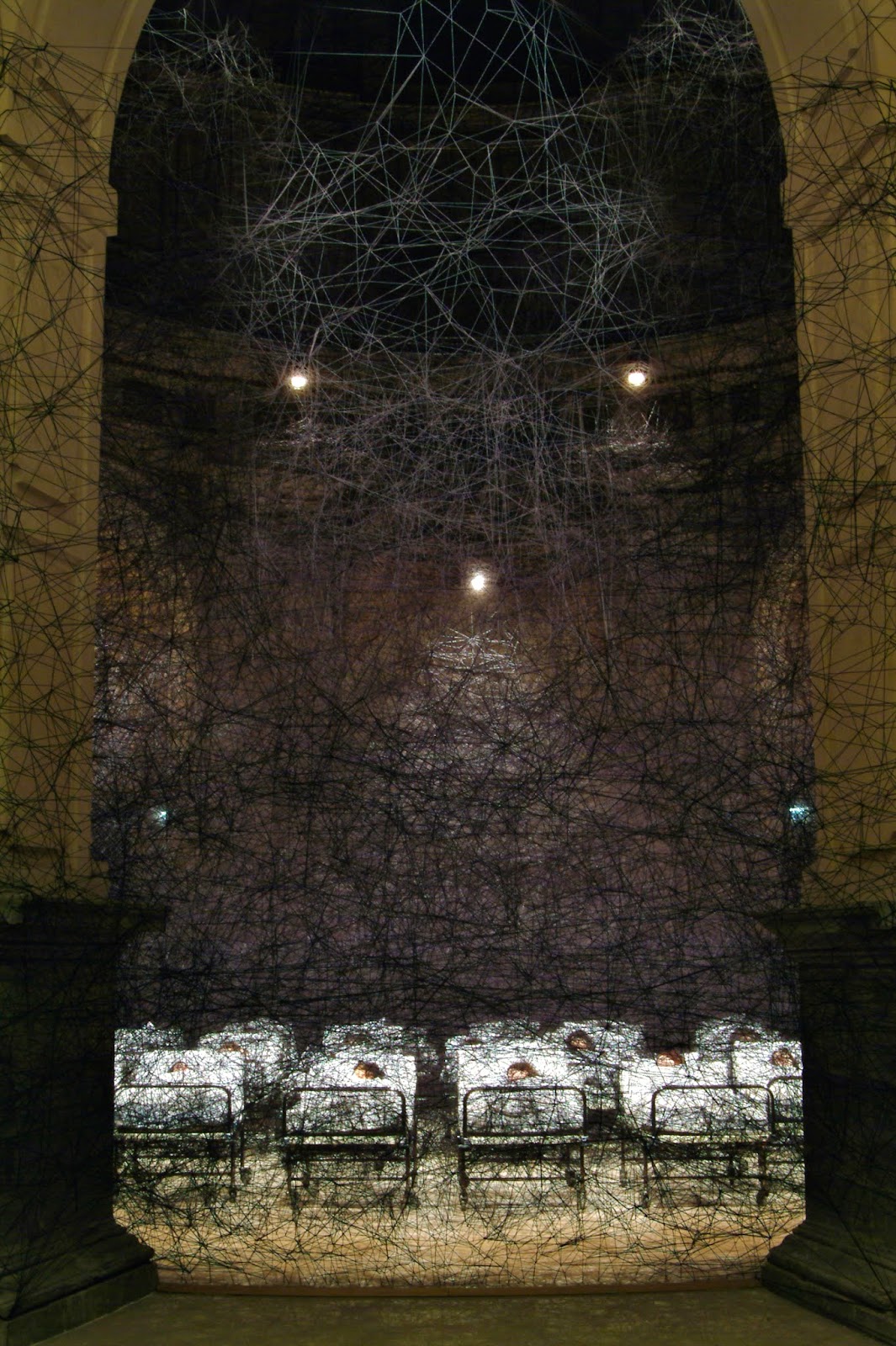 |
| Chiharu Shiota, During Sleep, (2004),
Saint-Marie-Madeleine, Lille, France,
Thread, Beds, Performers Photographer: Sunhi Mang |
While
objects frequently figure as the central components of her installation
works, her works are also distinctively body-oriented, as evidenced in
works such as During Sleep, which features real-life women asleep
on hospital beds and the space enshrouded in her customary fog of
thread, bringing to forth gendered associations with the fairy-tale
Sleeping Beauty.


.JPG)
.JPG)


